Taxi vs Rideshare in New Zealand (2026): Real Costs, Surge Pricing, and How Ride Bidding Changes the Game
Getting from A to B in New Zealand’s cities has never offered more choices — or more confusion. Traditional taxis, global rideshare apps, shuttles, and now fare bidding platforms all compete for your trip. Prices for the same journey can vary wildly depending on the app you open, the time of day, and whether an algorithm has decided it’s “surge” time.
This guide breaks down how taxis and rideshare actually compare in New Zealand in 2026 — on cost, safety, availability, and airport rules — and explains a third model that’s gaining ground fast: ride bidding, where you propose the fare and drivers compete for your trip. That’s the model behind Baj’s ride bidding platform, built in New Zealand for New Zealand conditions.
The Traditional Taxi in New Zealand
Taxis remain a fixture at airports, hospitals, hotels, and city ranks. In NZ, all taxi and rideshare drivers operate under the same NZTA small passenger service rules — Passenger (P) endorsement, vehicle certification, and background checks — so the safety baseline is consistent across the industry.
Taxi strengths:
- Metered, regulated fares — no surprise surge multipliers
- Rank and hail availability without an app
- Drivers with area knowledge and eftpos in every car
- Accessible options like wheelchair taxis and maxi vans for groups
Taxi weaknesses:
- Often the most expensive option per kilometre
- Availability thins out in suburbs and smaller towns
- Booking by phone can feel dated
If you prefer the certainty of a professional booked car, Baj offers straightforward taxi booking across New Zealand with upfront pricing through the app — the reliability of a taxi with the convenience of modern tech.
Rideshare Apps: Convenient, Until the Surge Hits
App-based rideshare made booking effortless: tap, track, pay, rate. For everyday city trips it’s often cheaper than a metered taxi — until demand spikes. Concert finishing? Rain at 5 pm? Flight arrivals bunching up? Dynamic pricing can multiply your fare with no negotiation and no transparency about why.
Rideshare strengths:
- Fast pickup in busy urban areas
- Cashless, trackable, easy receipts
- Generally competitive base pricing
Rideshare weaknesses:
- Surge pricing — the fare is whatever the algorithm says today
- Commission-heavy models squeeze drivers, affecting service quality and driver retention
- Coverage gaps outside main centres
The Third Way: Ride Bidding — You Name the Fare
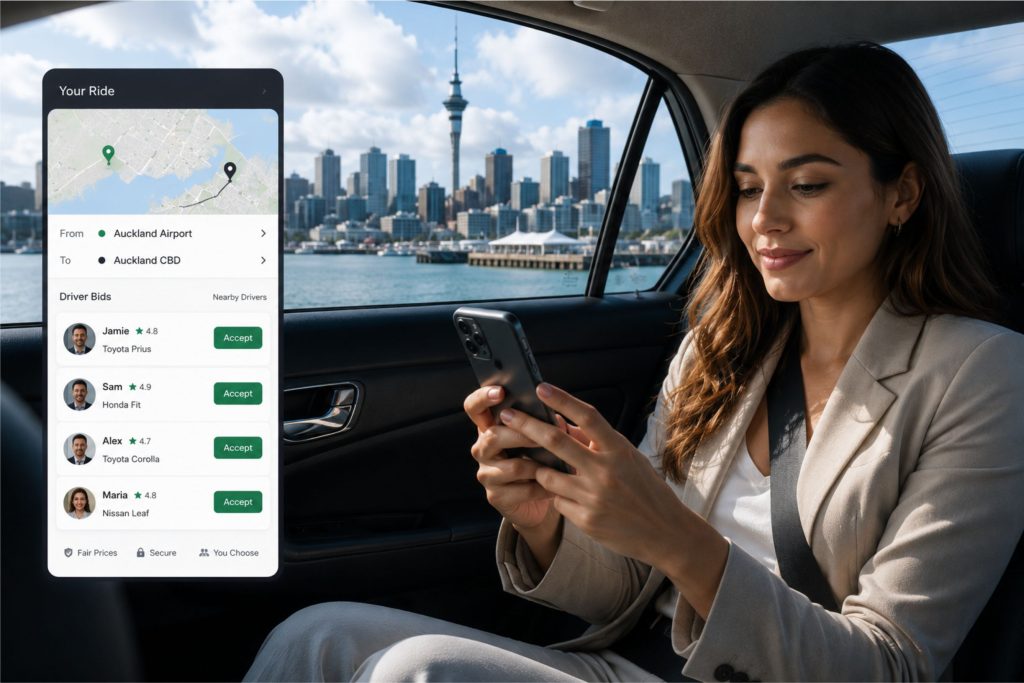
Here’s where things get interesting. Ride bidding flips the pricing model. Instead of accepting whatever a meter or an algorithm dictates:
- You enter your trip — pickup, destination, time.
- You propose a fare you’re comfortable paying.
- Nearby drivers respond — accepting your offer or counter-offering.
- You choose the driver based on price, vehicle, rating, and arrival time.
The result is a transparent mini-marketplace for every single trip. On quiet days, you’ll often ride for less than the standard app price. During busy periods, you decide how much extra the trip is worth to you — rather than an invisible surge multiplier deciding for you. We’ve written a deeper explainer on how Baj’s rider fare bidding system creates fair pricing if you want the mechanics.
Why drivers like it too: drivers see the offered fare before accepting, so they can choose trips that make economic sense — no more driving 15 minutes to a pickup that barely covers fuel. Baj pairs this with a low-commission philosophy through its Driver Operator Network, which treats drivers as transport entrepreneurs rather than gig-app inventory. (Curious about driving? See how to become a Baj driver.)
Cost Comparison: A Realistic Example
Take a typical 12 km cross-city trip in Auckland:
| Option | Typical Fare (off-peak) | Typical Fare (peak/surge) |
|---|---|---|
| Metered taxi | $35–$45 | $35–$45 (metered, no surge) |
| Rideshare app | $22–$30 | $40–$70+ with surge |
| Ride bidding | You offer — often $20–$28 | You offer — you control the ceiling |
The pattern most riders notice: taxis are predictable but pricey; rideshare is cheap until it isn’t; bidding gives you the levers. For airport runs and time-critical trips, many riders bid slightly above average to attract instant acceptance — still typically below surge rates.
Which Should You Choose? Quick Decision Guide
- Late-night city trip, surge active → Ride bidding. Set your ceiling; let drivers compete.
- Wheelchair access, maxi van, or corporate account → Book a Baj taxi with the vehicle type you need.
- Airport transfer with a deadline → Pre-book. Baj covers airport transfers nationwide with fixed, agreed pricing — no meter anxiety at 5 am.
- Intercity trip (e.g., Auckland → Hamilton, Christchurch → Queenstown) → Standard apps are weak here. Baj’s outstation long-distance transport is built exactly for private city-to-city travel.
- Sightseeing day → Skip point-to-point rides entirely and book a structured day tour with transport included.
One App Instead of Four
The quiet advantage of a multi-service platform: taxis, ride bidding, outstation travel, and tours across New Zealand live in a single account — one payment method, one support team, one trip history. We’ve covered the full ecosystem in our post on the Baj multi-service transport platform.
FAQs – Taxis, Rideshare & Ride Bidding in NZ
Is ride bidding legal in New Zealand? Yes. Ride bidding platforms operate under the same NZTA small passenger service framework as taxis and rideshare — licensed drivers, certified vehicles, and background checks. Only the pricing mechanism differs.
Will drivers accept a low bid? Bids reflect the market. Fair offers get picked up fast; lowball offers may wait or receive counter-offers. The app guides you with typical fare ranges so you can bid smart.
Is bidding slower than instant booking? Usually only by moments — driver responses arrive in seconds. If you’re in a rush, bid at or slightly above the suggested fare for near-instant matches, or use standard taxi booking.
Does Baj operate outside Auckland? Baj is building coverage across New Zealand — including Auckland, Queenstown, Christchurch, and beyond — spanning taxis, ride bidding, outstation travel, and tourism.
Can I use Baj for long trips between cities? That’s exactly what the outstation service is for: private, door-to-door, city-to-city travel at pre-agreed prices.
Stop paying whatever the surge says. Try ride bidding with Baj → or book a taxi anywhere in New Zealand →
Recent Posts
-
 Android or iPhone for BAJ Drivers? Which Phone Works With Each BAJ Service
 -
 BAJ Nationwide Driver Onboarding Update: Application Reviews and Next Steps
 -
 BAJ Gives Drivers More Flexibility with Cash, EFTPOS and Card Payments
 -
 Which Vehicle Should I Select in the BAJ Driver App?
 -
 BAJ Opens Registrations for Phased Nationwide Transport Platform Rollout